
How much does it actually cost to hire an employee in India in 2026?
In 2026, hiring an employee in India costs their gross salary plus an additional 10% to 17% in mandatory employer statutory contributions and medical benefits. For a mid-level software engineer earning a gross salary of ₹1,800,000 (~$21,600 USD) annually, your total employer cost to company (CTC) will average ~$24,500 to $25,200 USD per year before platform management fees.
Understanding the true price tag of hiring talent in India requires looking beyond the advertised base salary. Overseas founders and finance teams often make the mistake of budgeting based solely on gross pay, only to face budget overruns when local compliance mandates and statutory contributions take effect.
India’s employment landscape operates on a Cost to Company (CTC) structure. CTC represents the complete expenditure an employer incurs on an employee annually, combining basic pay, allowances, social security, and health benefits. Statutory load alone typically adds between 10% and 17% on top of gross compensation across mid-level to senior positions; our India employment cost calculator works it out for a specific salary.
When hiring remotely from the US, UK, or Europe, you must also factor in the administrative vehicle used to manage payroll. Whether you partner with an Employer of Record (EOR) or set up a local Indian entity, these structural expenses determine your final annual commitment.
What is the difference between Gross Salary, Net Pay, and CTC in India?
Gross salary is the total annual package pledged to the candidate before statutory deductions, whereas Net Pay (take-home) is what the employee receives after income taxes (TDS) and employee-side contributions. Cost to Company (CTC) is the true metric for employers, incorporating gross salary plus direct employer liability contributions like Employees’ Provident Fund (EPF) and Gratuity.
To build accurate payroll models, finance leaders must understand how an Indian compensation structure is divided into distinct operational buckets:
- Basic Salary: The core component of the compensation structure, typically accounting for 50% of the gross salary.
- Allowances: Flexible components such as House Rent Allowance (HRA), Special Allowance, and Leave Travel Allowance (LTA) designed to optimise employee tax efficiency.
- Employee Deductions: Deductions withheld directly from the employee’s gross pay, including Tax Deducted at Source (TDS) and the employee’s 12% share of EPF.
- Employer Liabilities: Direct out-of-pocket costs paid by the company over and above gross salary, including mandatory social security contributions and severance accruals.
Misunderstanding the distinction between gross pay and CTC often leads to salary miscommunications during international offer negotiations. Candidates expect their gross salary to meet local market benchmarks, while employers must budget for the full CTC load.
What statutory employer contributions and benefits are mandatory in India?
Indian labour law mandates employer contributions to the Employees’ Provident Fund (EPF at 12% of basic wages, up to the ₹25,000 monthly wage ceiling) and accrued Gratuity (~4.81% of basic salary) under the 50% basic pay wage rule. Employers also typically provide supplemental private health coverage ($150-$350 per employee/year) to remain competitive for remote tech talent.
Employer liabilities are codified under unified labour rules and must be remitted monthly or accrued systematically:
1. Employees’ Provident Fund (EPF)
Employers contribute 12% of the employee’s basic wages toward the EPF scheme. From 17 September 2026 the ceiling is ₹25,000 a month (it was ₹15,000), so the required employer contribution is at most ₹3,000 a month; contributing on wages above the ceiling is voluntary. Our guide to the new PF wage ceiling covers what changed. Under the Code on Wages (opens in a new tab), basic salary must constitute at least 50% of total gross compensation under Section 2(y), preventing companies from artificially lowering basic pay to reduce social security liabilities.
2. Statutory Gratuity
Gratuity is a statutory severance benefit payable to employees after five years of continuous service (after one year for fixed-term employees under the Code on Social Security). Employers must accrue approximately 4.81% of basic salary annually (15 days of basic pay per completed year of service) to fund this future liability.
3. Employees’ State Insurance (ESI)
Mandatory for employees earning a gross monthly salary of ₹21,000 (~$250 USD) or less. The employer contributes 3.25% of gross wages, providing statutory healthcare and disability cover.
4. Group Health Insurance & Perks
While not strictly mandated by law for higher earners, market norms dictate providing private health insurance covering the employee and their immediate family. Offering a $150-$350 annual medical policy along with remote setup stipends is standard practice to reduce turnover in hubs like Bengaluru, Hyderabad, and Delhi NCR. Bridge91’s Group Health Insurance covers employees and contractors from day one under Bridge91’s master policy.
EOR vs. Indian Legal Entity: At what headcount does setting up a Pvt Ltd make financial sense?
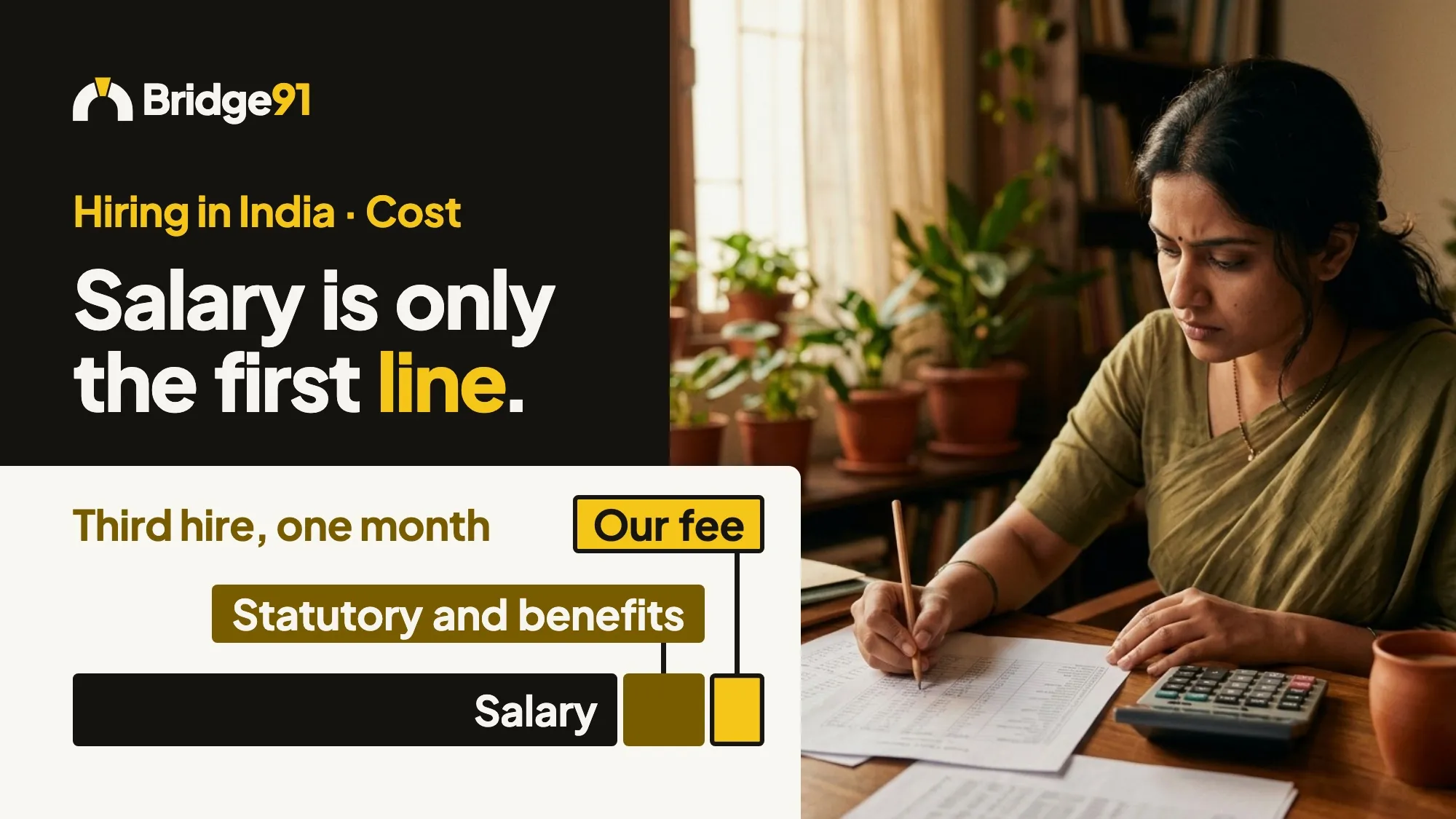
An Employer of Record (EOR) charges a monthly fee for each person, with zero upfront corporate entity overhead, so legally compliant onboarding can start straight away. At Bridge91, the introductory offer is $59 per employee per month for your first two hires; from your third hire, our fee is 8% of what you pay each month for that person. Incorporating a local Private Limited (Pvt Ltd) subsidiary costs $4,000-$8,000 upfront with $18,000-$30,000 in fixed annual legal, ROC, and tax audit compliance fees, which keeps EOR the cheaper option for teams below about 13 people on the worked example below.
When expanding into India, foreign executives face a structural choice: leverage an established EOR partner or incorporate a direct Indian legal entity (Wholly Owned Subsidiary).
Setting up a Private Limited entity means registering with the Registrar of Companies (ROC) through the Ministry of Corporate Affairs (opens in a new tab), obtaining local tax IDs (PAN and TAN), opening corporate bank accounts, and maintaining ongoing secretarial, Transfer Pricing (Form 3CEB), and statutory audit compliance.
For small teams, the fixed administrative overhead of a standalone subsidiary outweighs the per-person monthly fee of an EOR.
Worked Examples: What is the total hiring cost for 1, 5, and 10 employees in India?
Scaling your workforce in India increases direct labour costs predictably: the EOR fee grows with each person, while an entity adds a fixed overhead whatever its size. On the assumptions below, a five-person team through Bridge91 as Employer of Record costs about $146,600 a year, whereas the same team in your own subsidiary costs $162,000: equal salary costs plus about $24,000 in fixed annual corporate governance overhead.
To illustrate real-world budgeting, the following examples assume a gross salary of about $24,000 (₹2,000,000) per person per year, a typical figure for a mid-to-senior software engineer in India.
Cost Matrix: EOR vs. Subsidiary Setup (USD per Year)
| Headcount | Total Gross Salary | Statutory Load & Benefits (~15%) | Bridge91 Fee ($59 for the first two hires, then 8%) | Entity Maintenance & Audit | Total Annual Cost (EOR) | Total Annual Cost (Entity) |
|---|---|---|---|---|---|---|
| 1 Employee | $24,000 | $3,600 | $708 | $22,000 | $28,308 | $49,600 |
| 5 Employees | $120,000 | $18,000 | $8,616 | $24,000 | $146,616 | $162,000 |
| 10 Employees | $240,000 | $36,000 | $20,616 | $26,000 | $296,616 | $302,000 |
Note: Initial setup fees ($5,000 average) for legal entity incorporation are excluded from annual operating totals above. From the third hire, the Bridge91 fee is 8% of that person’s total monthly cost, the fee included: here $2,400 of $30,000 a year.
On these assumptions, Employer of Record stays cheaper than your own entity until about 13 people, before counting the entity’s setup fees and the months it takes to open. Past that point a direct subsidiary becomes financially advantageous if long-term expansion is planned, and Bridge91 Elevate moves your people onto your own new entity in about three months.
What hidden fees, FX markups, and cross-border invoicing surprises hit foreign employers?
Foreign employers frequently lose 2% to 5% on international payments through hidden FX spreads added by legacy banks or EOR providers on cross-border salary billing. Furthermore, failure to account for local Goods and Services Tax (GST at 18%) or reverse-charge mechanisms can lead to unexpected tax leakage on overseas invoices.
When reviewing cross-border payroll invoices, look closely at three operational cost drivers:
- Foreign Exchange (FX) Spreads: Many global payroll tools convert USD/GBP/EUR to INR using retail bank transfer rates rather than mid-market rates, surreptitiously adding 2% to 4% to monthly payroll costs.
- Goods and Services Tax (GST) Liability: Local administrative services in India carry an 18% GST rate. Ensure your billing framework properly leverages cross-border export-of-services regulations or reverse-charge mechanisms to prevent unrecoverable tax payments.
- Annual Inflation Adjustments: High competition for technical talent in Indian metropolitan hubs generates annual increment expectations of 8% to 12%. Failing to factor this indexation into multi-year financial forecasts leads to retention challenges down the line.
Bridge91 sends one monthly invoice, in your currency. No FX fee: the bank converts your payment to rupees and we share its FIRC with you.
Frequently Asked Questions about India Hiring Costs
What is the statutory probation period and notice period cost in India?
Probation periods typically last 3 to 6 months, during which notice periods range from 15 to 30 days. Standard notice periods after confirmation range from 30 to 90 days, during which full salary must be paid even if the employee is relieved early.
Are annual bonuses legally required when hiring staff in India?
Under the Code on Wages, which replaced the Payment of Bonus Act, a statutory bonus (8.33% to 20% of basic pay) is mandatory for employees earning below statutory salary thresholds. For higher-earning tech talent, performance bonuses are discretionary but standard for market competitiveness.
Can I hire workers in India as independent contractors to save costs?
While hiring contractors avoids statutory contributions, tax misclassification risks under Indian tax law (CBDT) carry severe back-tax penalties and statutory interest. If the worker works full-time hours under direct control, an EOR or subsidiary framework is legally required. Where a contractor arrangement is genuinely the right fit, Bridge91 CoR (Contractor on Record) engages them with GST invoices and Form 16A.
How long does it take to start paying employees in India via an EOR?
Onboarding an employee in India through an established EOR partner usually takes a few business days to about two weeks, compared to the weeks or months required to set up an Indian legal entity and open local bank accounts. With Bridge91, on average, a new hire’s first pay arrives within 24 hours of agreed terms.