
Why Bridge91: talent and business operations in India, end to end
India is one of the strongest expansion opportunities a company can take, and one of the easiest to slow down. A foreign business entering it usually ends up coordinating a recruitment agency, a payroll bureau, a firm of chartered accountants, corporate lawyers and property brokers, each with its own contract and its own view of the work. Entry slows, administration grows, and compliance gaps open at the hand-offs between them. Expanding well needs one partner that joins talent, back-office finance and tax, and physical workspace under one plan.
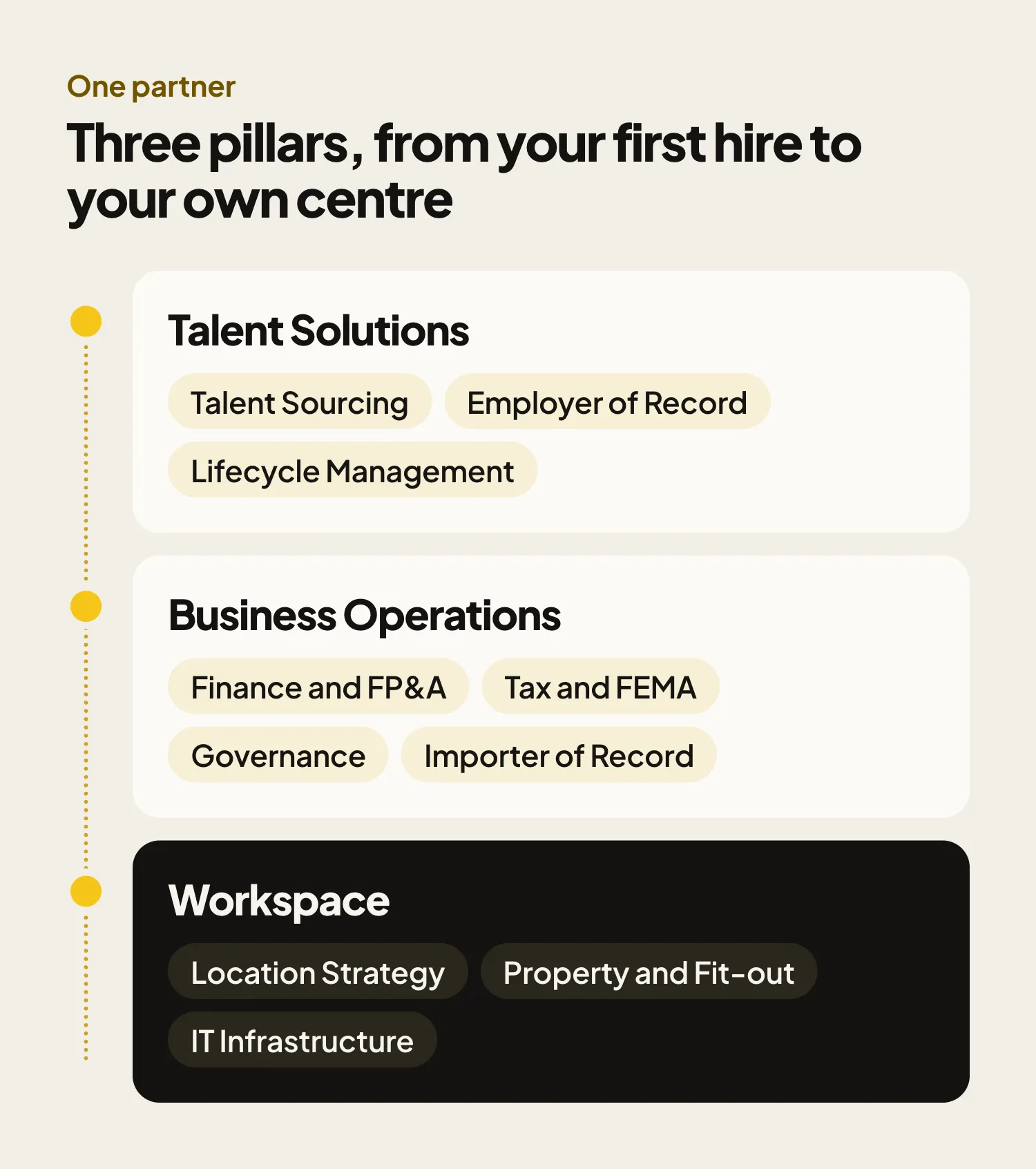
Bridge91 is that partner, organised in three pillars:
- Talent Solutions: sourcing, Employer of Record and lifecycle HR.
- Business Operations: finance and FP&A, tax and FEMA, governance, and Importer of Record.
- Workspace: location strategy, property and fit-out, and IT infrastructure.
Talent Solutions
A hiring strategy that lasts in India needs one continuous workflow: finding the person, employing them legally, then administering their employment for as long as it runs. Bridge91 runs all three, so a cross-border team is not managed through three vendors.
Talent Sourcing
Strong candidates in India come from targeted campaigns and real reach into the market, not from passive job postings. Talent Sourcing covers identification, active campaigns and screening across technical and non-technical roles, including:
- Software engineers, machine-learning engineers, DevOps engineers and QA engineers
- Product designers, data analysts and research analysts
- Financial controllers, accountants, and legal and compliance specialists
- Marketing managers, sales development representatives and recruiters
- Operations leads, project managers, technical writers and executive assistants
Recruitment runs across sectors, through our own networks and India’s main talent platforms. Every candidate is checked against the technical, commercial and cultural criteria you set before they reach your hiring process.
Employer of Record (EOR)
Employing someone in India has traditionally meant incorporating a local company first: months of applications and statutory registrations, and real capital tied up before anyone starts. Bridge91’s Employer of Record service removes that step.
Your new hire is employed on Bridge91’s own wholly owned Indian company and is live on payroll in under 24 hours. Bridge91 is the legal employer and carries the statutory employment obligations under Indian labour law. You direct the day-to-day work, manage the person as part of your team, and own all the intellectual property they create.
Talent Lifecycle Management
Administration does not stop once the contract is signed. Talent Lifecycle Management covers every stage of each person’s employment:
- Offer letter
- Statutory onboarding
- Monthly rupee payroll
- Benefits and equipment
- Exit and full and final settlement
In practice that means employment contracts written to Indian law, monthly payroll in rupees, statutory contributions, expense reimbursements, group health insurance from day one under Bridge91’s master policy, and a compliant exit with the full and final settlement paid on time.
People are the engine of growth in India. Financial integrity, tax compliance and governance are the structure that holds it up.
Business Operations
Back-office compliance is easy to treat as overhead. For a company operating across borders, it is what protects the value it builds. Bridge91’s Business Operations work is CA + CPA-led: financial, tax and regulatory work between your headquarters and India is directed by Chartered Accountants and a US CPA.
Finance: FP&A and GAAP reporting
When headquarters and the Indian operation report differently, budgets drift and the month-end close slows. Finance covers entity setup, financial planning and analysis, and multi-GAAP accounting. We reconcile Indian GAAP and Indian Accounting Standards (Ind AS) with US GAAP and IFRS, so your board sees one clear set of numbers and nothing is lost between the two.
Tax: income tax, GST, transfer pricing and FEMA
Indian tax needs specialist oversight and a strict filing calendar. Tax covers:
- Income tax and withholding: PAN and TAN, monthly tax deducted at source (TDS), quarterly Form 24Q returns and an annual Form 16 for each employee.
- Goods and Services Tax (GST): registration, monthly returns and input tax credit across your spending in India.
- Transfer pricing: arm’s-length intercompany service agreements and the transfer pricing documentation an international group needs.
- Foreign Exchange Management Act (FEMA): money coming into India through Authorised Dealer Category-I banks, conversion from US dollars to rupees, and the regulatory filings that go with it.
Governance
Staying in good standing in India means keeping to company law. Governance covers board structures, statutory filings with the Registrar of Companies, secretarial records, and compliance across every unit you operate.
Importer of Record
Bringing your own equipment into India without a local entity means customs clearance, duties and tax registrations you cannot hold yourself. As your Importer of Record, Bridge91 stands as the importer: the shipment clears customs in Bridge91’s name, duties and taxes are paid in India and itemised on your monthly invoice, and the equipment is delivered and recorded under our IT asset management.
People and finance both need somewhere to work. That is the third pillar.
Workspace
As a team grows, a company has to balance remote work against a physical office. Bridge91’s Workspace pillar builds Global Capability Centres end to end, so you deal with one team rather than a dozen brokers, designers and IT vendors.
Location strategy
The right city depends on the depth of talent, property costs, transport and the industry clusters around you. Location strategy compares India’s main metros, including Hyderabad, Bengaluru and Delhi NCR, with the growing tier-2 technology cities, to find the right base for the work you need to do.
Property and fit-out
Once the city is chosen, Property and fit-out covers finding and leasing commercial space and turning a warm shell into an office that carries your brand: architectural fit-out, space planning, security and amenities, all to your global standards.
IT infrastructure
An office needs secure connectivity from day one. IT infrastructure covers network design, redundant high-speed connectivity, workstations, security configuration, and asset tracking and maintenance for the life of the office.
With all three pillars under one roof, the first step into India becomes a small one: a single hire, on payroll in under 24 hours.
Onboarding in under 24 hours: how Bridge91’s EOR works
Incorporating, opening a bank account and registering before anyone can be employed takes months. Through Bridge91 it is four steps, and a new hire is live on payroll in under 24 hours.

Step 1: Tell us who you are hiring
You name the person, the role, the total package (cost to company, or CTC) and the start date. Any role, at any level of seniority.
Step 2: Contract and statutory registration
Bridge91 issues an employment agreement written to Indian labour law. Once it is signed, we register the person for the Employees’ Provident Fund (EPF), for Employees’ State Insurance (ESI) where it applies, and for tax deducted at source (TDS).
Step 3: Monthly rupee payroll and benefits
Bridge91 runs payroll in rupees, deposits statutory contributions with the government, processes approved reimbursements, and enrols the person in our master group health insurance policy, with cover from day one.
Step 4: One dollar invoice, at actuals
Each month you receive one invoice in US dollars. Every local cost is itemised line by line (gross salary, employer statutory contributions, insurance) beside a stated service fee. There is no FX fee and no margin on conversion: the bank converts your dollars, and we share its FIRC for each receipt.
The four steps at a glance:
| Step | What happens | What you receive |
|---|---|---|
| 1. The role | You send the role, CTC and start date | A salary structure and CTC breakdown |
| 2. Onboarding | An Indian employment agreement is signed | Registration for EPF, ESI where it applies, TDS and professional tax |
| 3. Payroll and benefits | Monthly rupee payroll runs and benefits start | Active payroll, and group health cover from day one |
| 4. Invoicing | One consolidated US dollar invoice, every month | Every cost itemised at actuals, plus a stated fee |
Steps 1 to 3 take under 24 hours on average. Step 4 then repeats every month.
Employing one person well is the foundation. The next question is how to grow from there.
From first hire to a full GCC, stage by stage
Expansion into India pays best when it grows in deliberate stages, rather than committing capital to property and incorporation before the first person is in their seat.

Stage 1: First hire through EOR
Most expansions start with one key person: a senior software engineer, a financial controller, a country manager. At this stage you hire through Bridge91’s Employer of Record. There is no entity to set up in India, no security deposit and no upfront capital. The person is on payroll in under 24 hours, and you can test the market quickly.
Stage 2: A growing team
As the work grows, so does the team. At this stage Bridge91 recruits across several roles, buys and dispatches equipment through IT Asset Management, provides group health insurance, and keeps you compliant in each state your people work in, including that state’s professional tax and Shops and Establishments registration.
Stage 3: Bridge91 Elevate, the move to your own entity
When your team reaches the size where an Employer of Record is no longer the right structure, you can move to your own Indian company. Bridge91 Elevate is the structured route from EOR to an entity you own, and it takes about three months end to end:
- Incorporation: a wholly owned Indian subsidiary of your company, under the Companies Act 2013.
- Registrations: every national and state registration it needs, including EPF, ESI, GST, professional tax, TAN and PAN.
- FEMA banking: corporate bank accounts opened through Authorised Dealer banks, in line with FEMA.
- Moving your people: each person transferred from Bridge91’s payroll onto your company’s payroll, with no break in their work and no missed payslip.
Stage 4: Full GCC operations
With your own entity in place, Bridge91 builds out the full Global Capability Centre: a permanent workspace, local board governance, financial controllership and full operating independence. The result is an Indian centre that runs as part of your company.
The four stages at a glance:
| Stage | Legal employer | Administration on your side | The focus |
|---|---|---|---|
| 1. First hire | Bridge91’s entity; you need none | Minimal | Testing the market quickly |
| 2. Growing team | Bridge91’s entity; you need none | Low, fully managed | Scaling across roles, with equipment |
| 3. Bridge91 Elevate | Your entity, being incorporated | Moderate, during the move | Your own entity and the payroll transfer |
| 4. Full GCC | Your wholly owned entity | Full local control | A permanent centre of your own |
Every stage, from the first EOR hire to a centre of several hundred seats, rests on statutory compliance.
Statutory compliance and risk in India
Employment in India is governed by central and state law together. Treating compliance as back-office paperwork, rather than as risk management, exposes a foreign company to penalties, disruption and, in some cases, personal liability for its officers.
Statutory contributions and deductions: EPF, ESI, PT and TDS
Indian law requires specific employer contributions and employee deductions, each one calculated, deposited and reported on a fixed monthly schedule.
Employees’ Provident Fund (EPF)
- Contribution: 12% of wages from the employer, and 12% from the employee.
- Who joins: everyone whose wages are ₹25,000 a month or less joins from their first day. The wage ceiling rose from ₹15,000 to ₹25,000 on 17 September 2026. The required employer contribution is 12% of wages up to that ceiling, at most ₹3,000 a month; many employers contribute on full basic pay instead, by agreement with the employee.
- The half-of-pay rule: under the Labour Codes, basic pay must be at least half of total remuneration. Allowances above half are added back into wages, so basic pay can no longer be kept low to keep provident fund down.
More in our guide to Provident Fund.
Employees’ State Insurance (ESI)
- Contribution: 3.25% of gross pay from the employer, and 0.75% from the employee.
- Who it covers: employees whose gross pay is ₹21,000 a month or less. Above that, no contribution is due from either side.
Professional tax (PT)
- What it is: a tax on employment income, set by each state. Some states do not levy it at all.
- How much: no more than ₹2,500 a year. Telangana charges up to ₹2,400 a year; Delhi does not levy it.
- Where it applies: where the employee actually works, so a person working from home can create an obligation in a state where you have no office. Where Bridge91 is the employer of record, the registration is ours.
Tax deducted at source (TDS)
- What it is: income tax withheld from pay each month at the employee’s own rates, and deposited with the government by the 7th of the following month.
- Reporting: quarterly returns on Form 24Q, and an annual Form 16 that each employee uses to file their own return.
A worked example: ₹1,00,000 a month
Basic pay is the figure the statutory costs are worked out from. Take a package of ₹12,00,000 a year.

An illustrative structure for a CTC of ₹1,00,000 a month:
| Line | How it is worked out | Monthly (₹) |
|---|---|---|
| Basic pay | Half of the package, to meet the Labour Codes | 50,000 |
| House rent allowance (HRA) | A structured allowance | 25,000 |
| Special allowance | The balancing figure | 16,595 |
| Gross salary | Earnings before the employee’s deductions | 91,595 |
| Employer provident fund | 12% of basic pay: ₹50,000 × 12% | 6,000 |
| Gratuity provision | Indicative monthly accrual, about 4.81% of basic | 2,405 |
| Monthly CTC | Gross salary plus employer contributions | 1,00,000 |
Illustrative. This structure pays provident fund on full basic pay. The required minimum is 12% of the ₹25,000 ceiling, ₹3,000 a month, and the difference would move back into the special allowance. Model your own figures with the India employment cost calculator.
Employee rights: gratuity and maternity leave
Gratuity
- The formula: gratuity = (last drawn basic pay ÷ 26) × 15 × completed years of service.
- When it is paid: on exit, once five years of continuous service are complete.
- How we handle it: rather than leaving gratuity to be discovered when someone resigns, Bridge91 provisions it monthly, so the cost is visible from the first payslip. On a basic of ₹50,000 a month the indicative accrual is about ₹2,405 a month.
More in our guide to Gratuity.
Maternity leave
- The entitlement: 26 weeks of paid maternity leave for a woman with fewer than two surviving children, up to eight of them before the birth. From the third child it is 12 weeks.
- Who pays: the employer pays her full average wage throughout, with no government subsidy, unless she is covered by ESI, in which case ESI pays. Bridge91 keeps her payroll running and the leave compliant.
Corporate and regulatory compliance: Shops and Establishments, and FEMA
Shops and Establishments registration
Commercial establishments in India register under their state’s Shops and Establishments Act, and each state has its own version. Whether it applies to someone working from home depends on the state, and the prudent position is to assume it does until that state says otherwise. Where Bridge91 is the employer of record, the employment sits on our Indian entity and the establishment registrations are ours.
FEMA and paying from abroad
The Foreign Exchange Management Act governs every flow of foreign exchange into India, including paying people who work there, which is why a foreign company cannot simply wire salaries into Indian bank accounts. Bridge91 receives your US dollars through an Authorised Dealer Category-I bank. The bank converts them to rupees, with no FX fee from us and its FIRC shared with you, and we pay salaries and statutory dues and complete the reporting the Reserve Bank of India requires.
What Bridge91 handles, in one table:
| Obligation | Rate or formula | Applies when | How often |
|---|---|---|---|
| Provident Fund (EPF) | 12% of wages, from each side | Wages up to ₹25,000 a month must join; basic at least half | Monthly |
| State Insurance (ESI) | 3.25% of gross pay from the employer | Gross pay of ₹21,000 a month or less | Monthly |
| Professional tax (PT) | Set by each state, at most ₹2,500 a year | Varies by state; Telangana up to ₹2,400 a year | Set by each state |
| Income tax (TDS) | The employee’s income tax rates | Withheld from taxable pay | Deposited monthly; Form 24Q quarterly |
| Gratuity | (Basic ÷ 26) × 15 × years | Paid after five years of continuous service | Provisioned monthly; paid on exit |
| Maternity leave | 26 weeks, paid | Employer-funded unless ESI covers her | When it arises |
| Shops and Establishments | A state fee | In each state where the establishment operates | On registration and renewal |
| FEMA | The bank’s conversion rate; no FX fee from us | Every inbound transfer | Each transfer, reported to the RBI |
Who needs all this, and why it matters which provider carries it, is the next question.
Who Bridge91 is for, and how it compares
Three groups need compliant employment in India: global companies expanding there, Indian companies that need flexible staffing, and Indian professionals working for foreign clients who want to know what actually reaches them.
Global employers
For a company based in the US, the UK or Europe, entering India without a local entity used to mean risking non-compliance or spending months incorporating. Bridge91 is a way in from the first day: no setup fee, no security deposit and no minimum term. You can build a team in India quickly, with an Indian employer carrying the employment obligations. More for global employers.
Indian companies
Indian companies often have work where putting people on their own payroll is not the right answer:
- Project and fixed-term hiring: a project needs twelve people for nine months. We employ them for the duration, with a clean end and no restructuring on your side.
- Ramp-up ahead of headcount approval: bring critical people in through Bridge91 while internal approval catches up.
- Trial before absorption: see how people perform in your environment, then absorb whoever you want to keep onto your own rolls, on terms agreed in advance.
- Hiring outside your states: employ people in states where you have no office and no Shops and Establishments or professional tax registration of your own.
Principal employer liability: four checks
When a staffing vendor fails to pay wages or deposit statutory dues, the law can look to the principal employer, which is you, to make good. A bundled rate on one line makes that risk hard to see. The answer is not a cheaper vendor. It is compliance you can check. Ask any vendor, including us, for:
- The challans: the monthly EPF and ESI payment challans for each of your people.
- The returns: the state professional tax returns and the quarterly TDS returns on Form 24Q.
- The registrations: proof of Shops and Establishments registration in every state where your people work.
- The costs: an itemised cost for each person, reconciled against what you are billed.
Ours are available to you. More for Indian companies.
Indian professionals
Professionals in India who work for a foreign client through an intermediary often cannot see the margin in the middle. The client pays a rate, and what reaches the professional is a part of it. Markups in this market are rarely disclosed and vary enormously. Bridge91 works at actuals with a stated fee.
An illustrative example
Take a foreign client paying ₹3,00,000 a month for a senior professional in India:
| Each month | Through an intermediary | Through Bridge91 |
|---|---|---|
| What the client pays each month | ₹3,00,000 | ₹3,00,000 |
| Retained in the middle | Not disclosed | ₹15,000, a stated service fee |
| Statutory and employment cost | Deducted from the balance | ₹12,000, at actuals, itemised |
| Available for the professional’s pay | ₹1,40,000 | ₹2,73,000 |
In this example, ₹1,33,000 a month more reaches the professional from the same client payment, with provident fund, gratuity and group health cover still in place. The figures are illustrative; whatever the numbers are in your case, you are entitled to know them. More for professionals in India.
Bridge91 and the multi-country EOR platforms
Many global Employer of Record platforms sell coverage in well over a hundred countries. To reach that many, they own entities in some countries and work through local partner firms in others, a layer the client never meets and cannot audit. That structure is worth checking before you sign, whoever you sign with.
Bridge91 works through one wholly owned Indian entity: Bridge91 Corporate Services Private Limited, in Hyderabad, Telangana. Payroll, tax and HR work is run in-house, directed by:
- Bhanu Yelchuri, LinkedIn profile, opens in a new tab, CPA(USA), CA, Advisor, Tax and Compliance: Chartered Accountant and US CPA, with ten years at KPMG and PwC advising international businesses on Indian compliance and United States taxation. He sits on the board.
- Naga Durga Sudhakar, Director, Finance: Chartered Accountant with over two decades in financial reporting and assurance, specialising in IFRS, Ind AS and technical accounting advisory.
- Bhavani Shankar M, Advisor, AI: Chartered Accountant with expertise across audit, controllership, risk management and CFO roles, built through Big Four assurance, global banking, microfinance and venture-backed consumer technology.
- Sriram Vinnakota, Director, Technology and AI: master’s in artificial intelligence from a Russell Group university in the UK. Leads the technology roadmap, including the Bridge91 web platform, and takes every first call.
Questions worth asking any Employer of Record in India, and our answers:
| The question | Bridge91’s answer |
|---|---|
| Who is the legal employer in India? | Bridge91 Corporate Services Private Limited, our own wholly owned entity. No partner layer |
| Who directs the statutory work? | Chartered Accountants and a US CPA, formerly of KPMG and PwC |
| Who designs the salary structure? | We do, with you, under the Labour Codes, before the offer goes out |
| How are costs billed? | Itemised at actuals plus a stated fee. No FX fee, and the bank’s FIRC is shared with you |
| What happens when you outgrow an EOR? | Bridge91 Elevate builds your own entity and moves your people onto it |
| Who answers when something goes wrong? | One named point of contact, with support 24/7 by WhatsApp and email |
| Is advice on FEMA, GST and transfer pricing in-house? | Yes, from the same people who run your payroll |
For sourced, dated comparisons with named providers, see our comparison pages.
Commercial terms and the details
Commercial terms
Bridge91’s terms are set out in full so that your costs are predictable:
- Setup fee: none.
- Security deposit: none.
- Minimum term: none, with a reduced-notice exit in the first three months.
- Employer of Record pricing: from $59 per employee per month. Every other service is scoped to what you need. See pricing.
- Invoicing: one monthly invoice in US dollars, with every local cost itemised at actuals beside a stated service fee. No FX fee.
IT Asset Management
Buying, configuring and recovering equipment across India is hard to run from abroad. Bridge91’s IT Asset Management covers the whole cycle:
- Procurement and configuration: laptops and other equipment bought, set up with your software image, and tagged.
- Delivery: shipped to each person, anywhere in India.
- Tracking: every asset recorded against the person who holds it, for as long as they work with you.
- Recovery: collected when someone leaves, with a condition report, then stored or sent on to the next person.
Contractor management: Bridge91 CoR
Engaging independent contractors in India needs agreements written for Indian law and correct classification, or a contractor can end up being treated as an employee. Under Bridge91 CoR (Contractor on Record), contractors are engaged on agreements drafted for India. We handle classification, deduct TDS, issue Form 16A certificates, and treat GST correctly on every contractor invoice.
The H-1B alternative: the arithmetic
Bringing an Indian professional to the United States on an H-1B visa is slow and uncertain. Employing the same person in India through Bridge91 is neither.

The first year, side by side:
| In the first year | Relocate to the US on an H-1B | Employ in India through Bridge91 |
|---|---|---|
| Annual salary | $120,000 to $150,000 | $25,000 to $45,000 |
| Visa and immigration fees | $100,000+ per petition | None |
| Relocation | $10,000 to $30,000 | None |
| Time to productive | 12 to 18 months | Under 24 hours |
| Certainty of outcome | A lottery | Certain |
| First-year total | $250,000+ | $30,000 to $60,000 |
That is up to $220,000 back in the first year, for each hire, without the immigration risk or the wait. More on why India.
Five reasons to work with Bridge91
- CA + CPA-led: statutory work is directed by a Chartered Accountant and US CPA with Big Four experience, so cross-border tax and Labour Code compliance sit with people qualified to do it.
- One wholly owned entity: everyone we employ sits on Bridge91 Corporate Services Private Limited, Hyderabad. There is no third-party firm between us and your people.
- Under 24 hours, with no deposit: a new hire is live on payroll in under 24 hours, with no setup fee, no security deposit and no minimum term.
- Itemised at actuals: one monthly invoice in US dollars, every cost on its own line, plus a stated fee.
- A built-in way forward: from a single hire through an Employer of Record to your own entity and a full GCC, through Bridge91 Elevate.